What Content Should Your Team Be Producing at Every Stage of the Customer Journey?

Stacy Wu
-
April 30, 2026
-
3 mins


Most CS and RevOps teams have a content problem that does not show up on a dashboard. The problem is not that they lack content. It is that the content they are producing is misaligned with where the customer actually is. A renewal deck shared during onboarding lands flat because the customer has not yet seen the value it is supposed to prove. An ROI one pager sent before meaningful product adoption does not move the conversation forward.
Every stage of the customer journey calls for different data, different formats, and a different goal. Here is a breakdown of what belongs where.
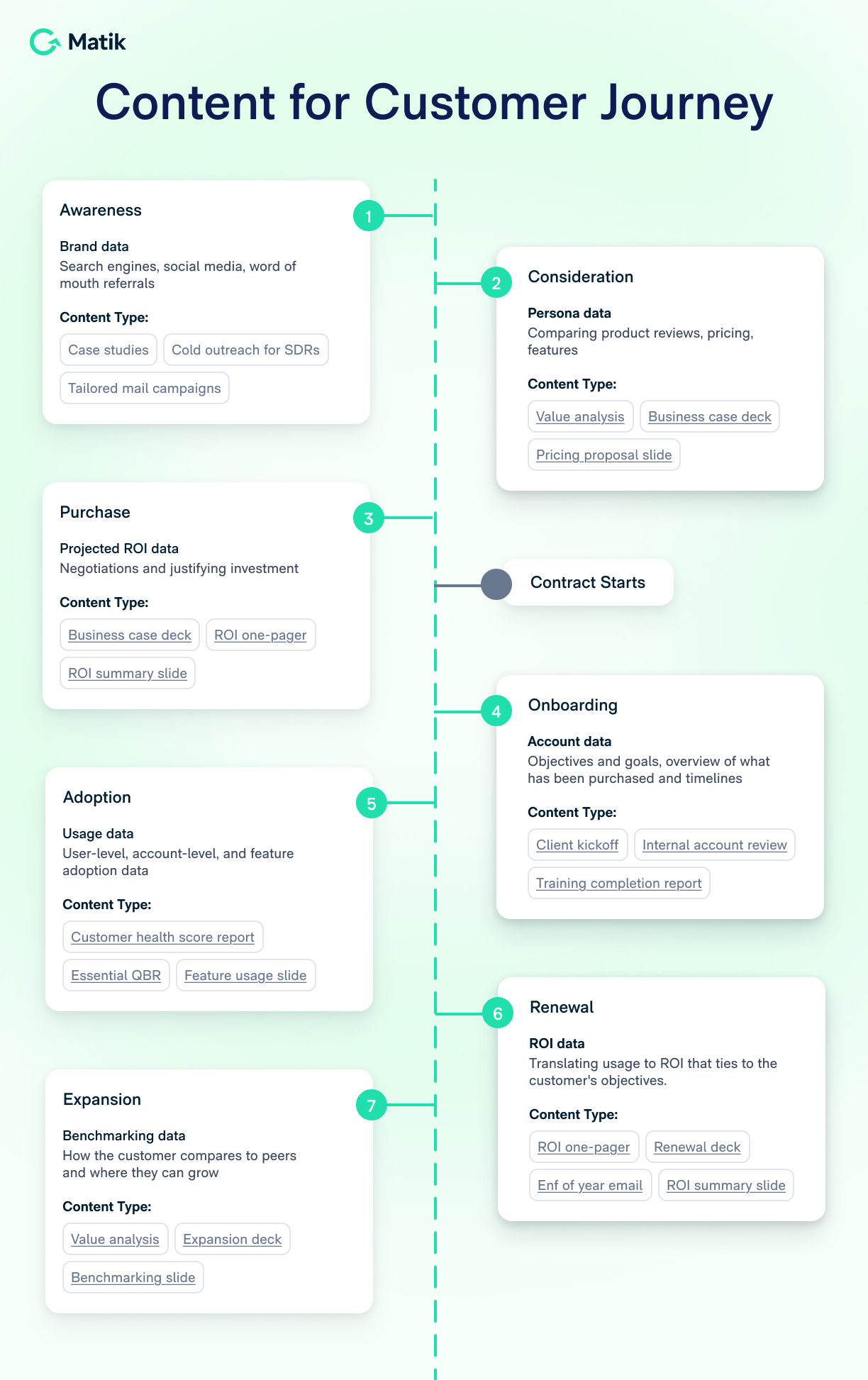
Data: Brand data from search engines, social media, and word of mouth
The customer knows they have a problem. They do not yet know you. Content here should meet them where they are already looking.
Content that works:
Data: Persona data from product reviews, pricing comparisons, and feature evaluations
The customer knows you exist and is comparing options. Content here needs to answer the specific questions a buyer at this stage is already asking.
Content that works:
Data: Projected ROI data used in negotiations and investment justification
This is where the financial conversation becomes explicit. A projected ROI figure that cannot be defended in a CFO conversation does more damage than no figure at all. Content here must speak the language of a financial buyer.
Content that works:
Data: Account data covering objectives, purchased products, and implementation timelines
Once the contract starts, the customer's question changes from "should I buy this" to "how do I get value from what I bought." The content here is about alignment.
Content that works:
Data: Usage data at the user, account, and feature level
Adoption is where data-driven content has the most direct impact on outcomes. A customer who is not using the product well is a churn risk. A customer using specific features heavily is an expansion opportunity. Content here should reflect what the data actually shows for that account.
Content that works:
Data: ROI data that translates product usage into customer objectives and business outcomes
If a CS team has been communicating value throughout the relationship, the renewal conversation is a continuation of that story. If not, it becomes a negotiation. Content here should tie directly back to the specific objectives the customer had at the start.
Content that works:
Data: Benchmarking data showing how the customer compares to peers and where they can grow
Expansion conversations are easier when the customer can see the gap themselves. Content here gives the customer's champion something concrete to take internally when making the case for additional investment.
Content that works:
The gap between a renewal that closes smoothly and one that stalls is rarely the relationship. It is usually whether the CS team had the right content, built from the right data, ready before the conversation happened. The seven stages above are a framework for making sure that is always true.

Most CS and RevOps teams have a content problem that does not show up on a dashboard. The problem is not that they lack content. It is that the content they are producing is misaligned with where the customer actually is. A renewal deck shared during onboarding lands flat because the customer has not yet seen the value it is supposed to prove. An ROI one pager sent before meaningful product adoption does not move the conversation forward.
Every stage of the customer journey calls for different data, different formats, and a different goal. Here is a breakdown of what belongs where.
Data: Brand data from search engines, social media, and word of mouth
The customer knows they have a problem. They do not yet know you. Content here should meet them where they are already looking.
Content that works:
Data: Persona data from product reviews, pricing comparisons, and feature evaluations
The customer knows you exist and is comparing options. Content here needs to answer the specific questions a buyer at this stage is already asking.
Content that works:
Data: Projected ROI data used in negotiations and investment justification
This is where the financial conversation becomes explicit. A projected ROI figure that cannot be defended in a CFO conversation does more damage than no figure at all. Content here must speak the language of a financial buyer.
Content that works:
Data: Account data covering objectives, purchased products, and implementation timelines
Once the contract starts, the customer's question changes from "should I buy this" to "how do I get value from what I bought." The content here is about alignment.
Content that works:
Data: Usage data at the user, account, and feature level
Adoption is where data-driven content has the most direct impact on outcomes. A customer who is not using the product well is a churn risk. A customer using specific features heavily is an expansion opportunity. Content here should reflect what the data actually shows for that account.
Content that works:
Data: ROI data that translates product usage into customer objectives and business outcomes
If a CS team has been communicating value throughout the relationship, the renewal conversation is a continuation of that story. If not, it becomes a negotiation. Content here should tie directly back to the specific objectives the customer had at the start.
Content that works:
Data: Benchmarking data showing how the customer compares to peers and where they can grow
Expansion conversations are easier when the customer can see the gap themselves. Content here gives the customer's champion something concrete to take internally when making the case for additional investment.
Content that works:
The gap between a renewal that closes smoothly and one that stalls is rarely the relationship. It is usually whether the CS team had the right content, built from the right data, ready before the conversation happened. The seven stages above are a framework for making sure that is always true.